Fragments Interactive
Two ends of a folktale archive: Sagenland and Nachtdienst
Two browser games built from the Dutch Folktale Database: collect legends in the field in Sagenland, then file them at the archive by night in Nachtdienst.
During my PhD, I got to work with the Dutch Folktale Database, the Nederlandse Volksverhalenbank at the Meertens Institute. At the time it contained around 45,000 stories in various genres collected in the Netherlands. A few years back the database, manintained and developed by Theo Meder, was merged with the Flemish Folktale Database, enlarging it to over 100k stories. With over 40,000 different attestations, the most prominent genre in this renewed database – the Folktale Database of the Low Countries – is the legend: devils at crossroads, white women on the heath, will-o’-the-wisps over the bog, the neighbour who could bewitch your cows. In recent work I have been exploring the effect of collection and collector bias on the representation of cultural diversity. Here too, it is tempting to read that collection as a picture of what people in the Low Countries told each other. But every record in it went through a chain of hands. Someone told the story. A collector cycled to a farm, sat down at a kitchen table, asked the right question and wrote down the answer. Back at the archive, someone typed the record, decided what kind of story it was, gave it a number and filed it in a (digital) drawer.
As an experiment in science communication, I made two small browser games, one at each end of that chain. In Sagenland you are the collector, out in the field. In the second game, Nachtdienst, you are the assistant at the archive, filing what came in. Both are built on the same stories, and every story in either game is a real record from the Verhalenbank.
Sagenland: twelve days in the field
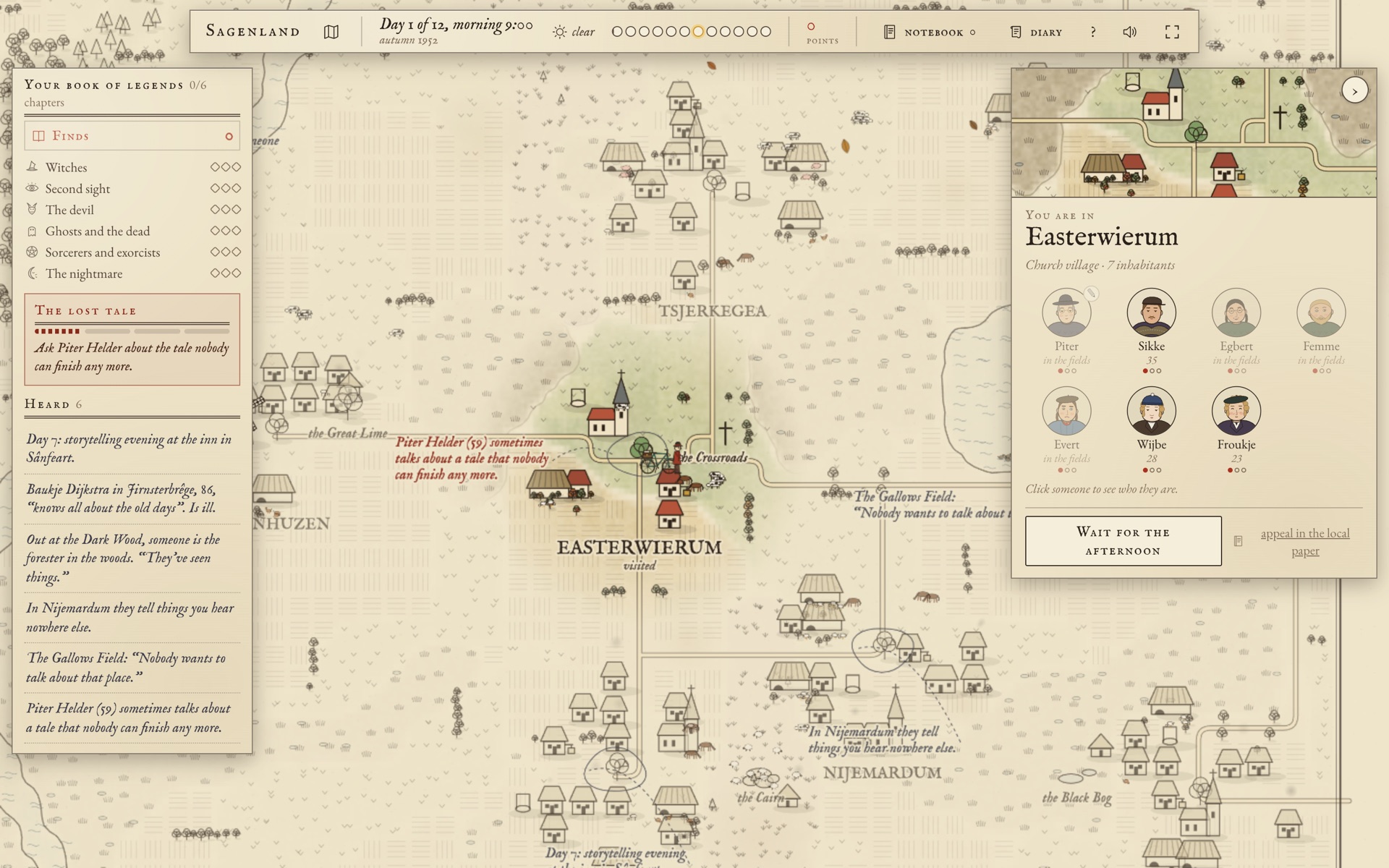
Sagenland: the field map by day.
You, the collector, start in one of seven regions: Friesland, the Low Saxon east, Limburg, Brabant, the Antwerp Kempen, or East or West Flanders. You have twelve days. During that time, your goal is to collect as many unique stories as possible. Rarer stories give more points than common ones. The people around you give clues: the landlady tells you about a storytelling evening at the inn, an old man who “knows everything about the past” but is ill, a shepherd out on the heath who “has seen things”, and a gallows field nobody likes to talk about. From there you’re on your own.
You choose what kind of collector you are, each loosely modelled on collectors who worked for the Meertens Instituut’s large folktale-collecting campaign of the 1960s and 70s, coordinated by J.J. Voskuil. There’s the persistent one on a bicycle, after the Frisian Jaarsma, who returned to the same tellers for years. There’s a touring fieldworker with a car and a tape recorder, after Kooijman. There’s the student on foot, working their own parish. And there’s a village doctor in a gig, after Bakker who was active in Waterland (just above Amsterdam), who heard tales at sickbeds but found that people hid their superstitions from the doctor.
Each game generates a new region of villages, roads, mills, churches, bogs and heaths, and then simulates eight years of village life before you set foot in it. People tell each other stories every week, more in winter and more in villages with an inn. Listeners remember some tales and forget others, and a new tale can push an old one out. People walk to neighbouring villages and take tales with them, peddlers come in from outside, and when old people die their children inherit part of what they knew. When you arrive, every village has its own tradition (or, at least, some distribution of stories).
I tried to connect places to the stories they tell: A village with a mill knows mill tales, and a village on the edge of the bog knows about will-o’-the-wisps. These links are computed from the corpus: which legend types mention a mill, a crossroads or the heath much more often than you’d expect.
When a tale is retold, especially by someone from another village, it sometimes changes into another real variant of the same type, picked from the most similar ones by text embeddings of the summaries, with a pull towards versions that mention what the new village has. Every version in the game exists in the archive.
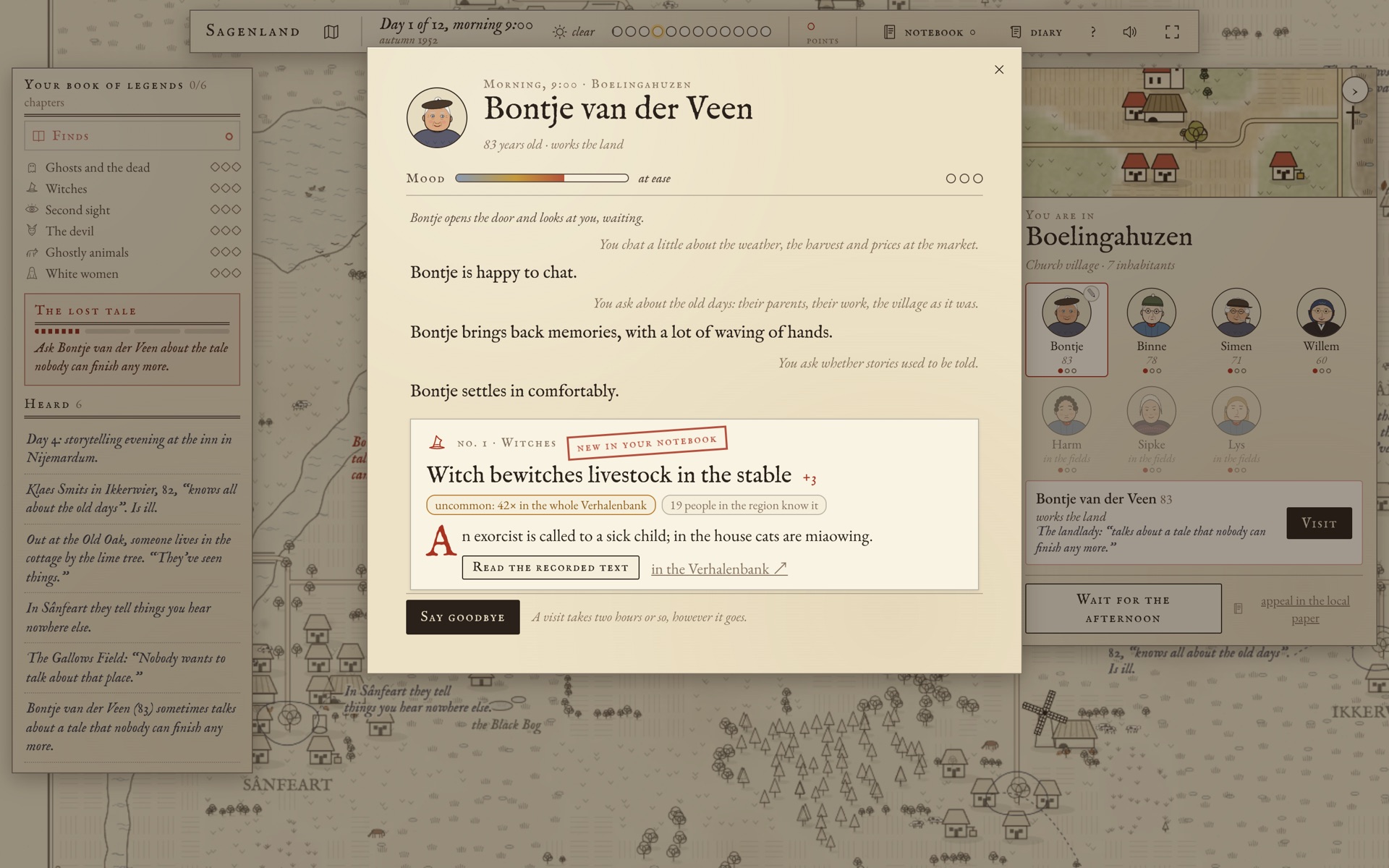
Sagenland: a visit.
When you visit people, you get three moves, four in the evening: small talk, the old days, a request for stories, a question about witches or the devil, or a tale of your own to jog someone’s memory. Some people are very good at story telling and tell freely but don’t believe a word of it. Other tell stories as something that really happened, but clam up if you ask about witches too soon (“You just want to laugh at us”). Then there those, the scoffers if you will, who know little but will tell you who believes “that old wives’ talk”. Some people are just shy but have great memory and tell you nothing until you name a tale, and then say “No, but I do know…”, which is straight from Jaarsma’s fieldwork. Push too hard and the visit is over: “I still have to see to the cows.”
The old and ill may die while you’re in the field, taking everything you didn’t write down with them. From day three, another collector works the region and likes to call on your best tellers. At night, lights dance over the bog and something white stands on the heath; go and look, and you’ll learn who to ask about it.
At the end the game sets your notebook against the world it came from: how many different tales were told, how many you wrote down, who died with what, and who you never visited. Then it does what a researcher would do with only your notebook: it estimates how many tales there must have been, with the Chao1 estimator from ecology, the method we used in Forgotten books (Kestemont, Karsdorp et al., Science 2022) to estimate how much medieval chivalric literature was lost. In the game you can see the true answer, and the estimate usually falls short. Collectors don’t sample at random: they go back to good tellers, follow tips, and ask about what interests them.
Nachtdienst: one night at the archive
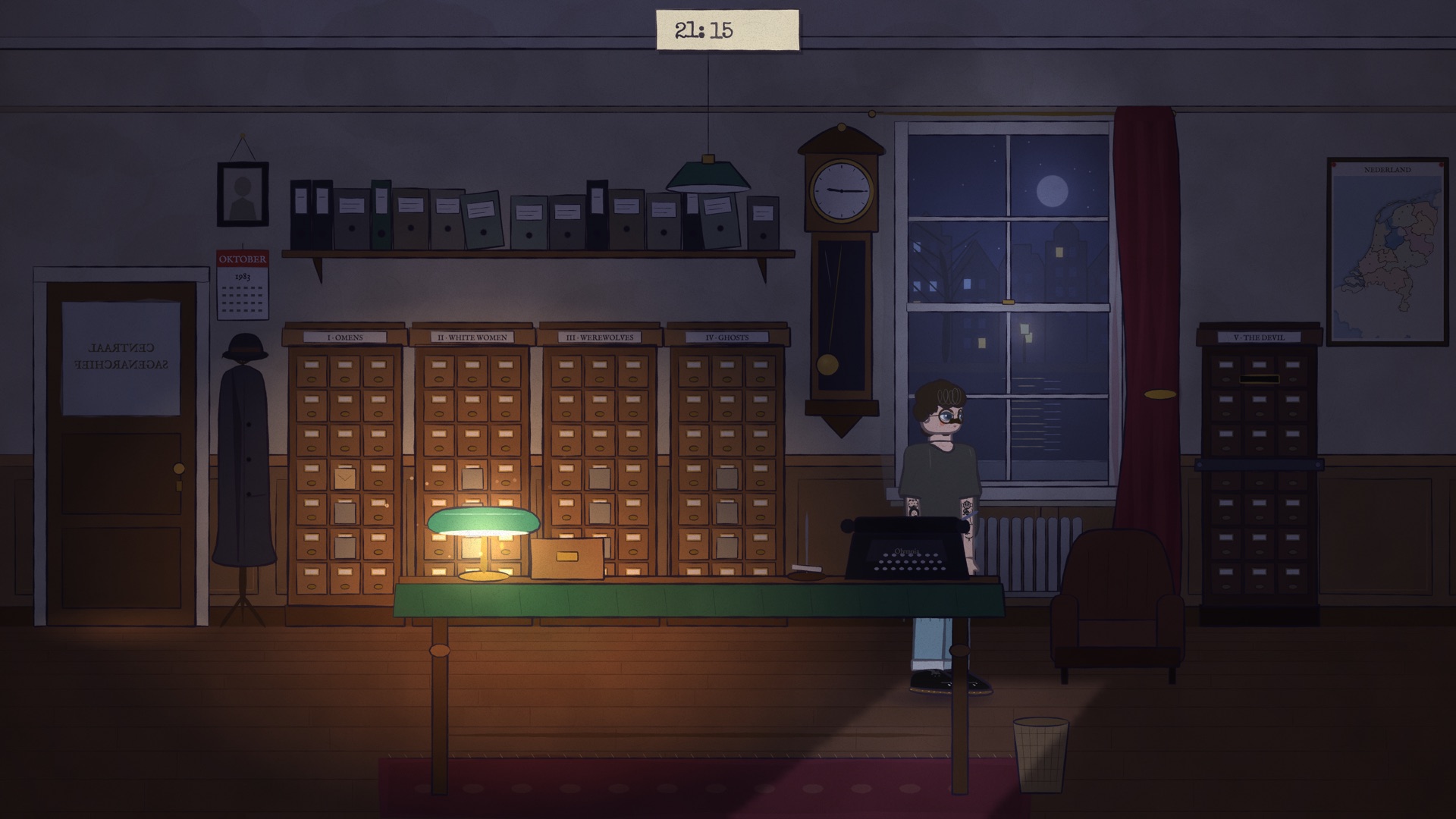
Nachtdienst: the reading room at a quarter past nine.
The second game sets a completely different vibe: it is 1983, a quarter past nine in the evening, in the Centraal Sagenarchief. The collector, J.D., has gone home and left a note on the reading table: “Twaalf enveloppen invoegen. Kast vijf blijft dicht. Sluit af vóór twaalven.” Twelve envelopes to file. Cabinet five stays shut. Lock up before midnight.
Along the wall stand five card cabinets, one for each kind of legend: omens of death, white women, werewolves, ghosts, and the devil, the one that stays shut. Each of the first four has three drawers of incoming cards, each with a envelope on top, and on the envelope J.D. has pencilled what is wrong. For instance, a card has lost its place name, and you pin it on the map on the wall between the three villages where the same legend was told. Or, a card is torn in two, and you have to find its bottom half in a box of loose halves with the same catalogue number. yet another asks you to indentify the card that belongs in another cabinet. The third drawer of each cabinet is a lock in the room: the clock stops, a place name appears in the mist on the window, something knocks at the door, the typewriter types half a card by itself…
A pipeline selects the 9,659 legends that fit the five cabinets, groups the tellings of each legend by the similarity of their summaries (the same kind of embeddings Sagenland uses to let stories change), and builds 120 nights of puzzles from them. Each puzzle is then checked by a program that never saw how it was made: it reads only the printed cards and has to arrive at the one right answer. Puzzles that fail are thrown away.
While a cabinet has unfiled drawers, its kind of legend seeps into the room. I made the game with Halloween in mind. So we hear the clock ticking too loudly and missing beats, or we see mist covering the window. Another time something goes along the ledge outside and leaves claw marks on the drawers. Why does the lamp flicker when you move? You can stop the leak by filing the last drawer of a cabinet.
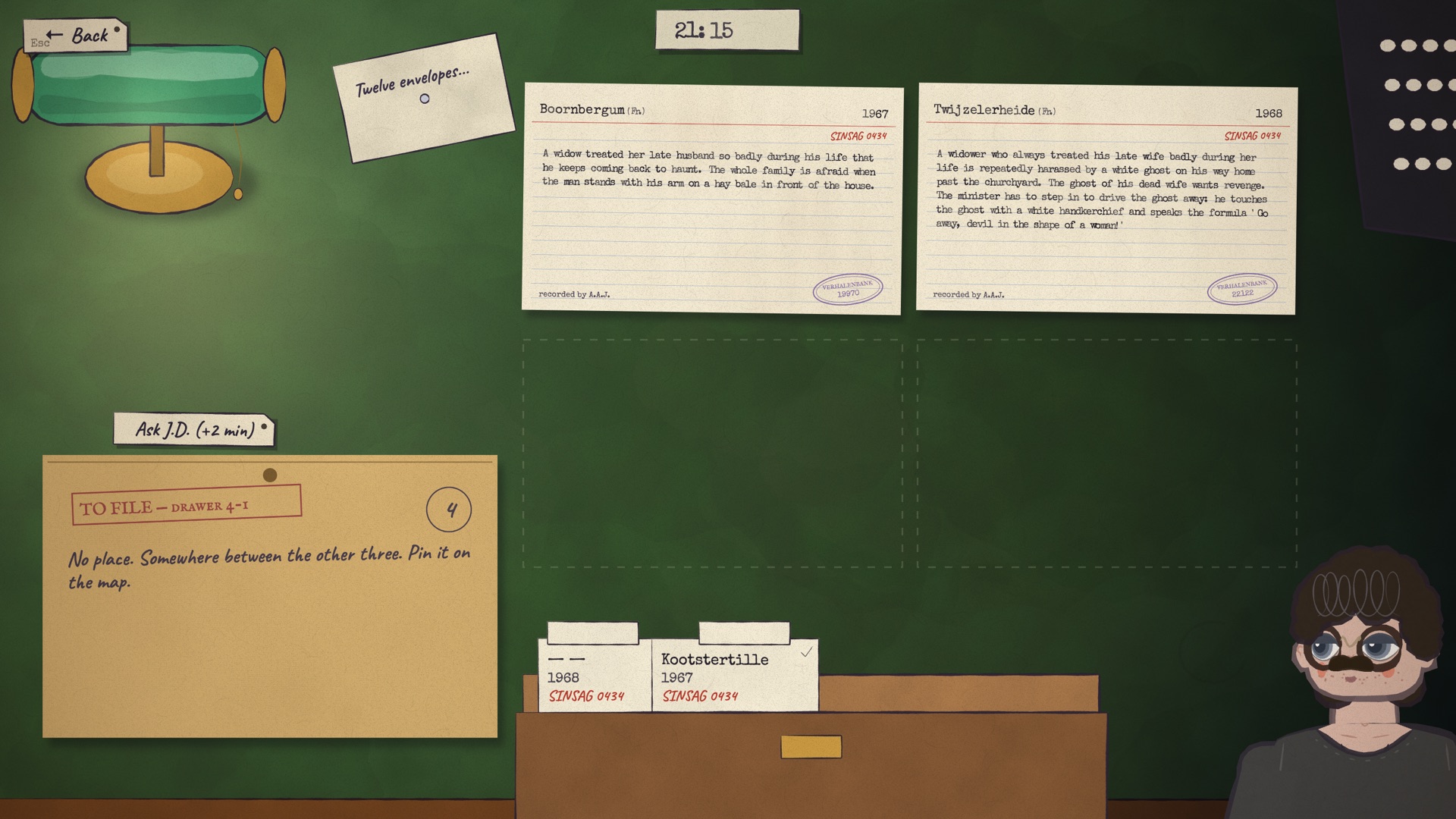
Nachtdienst: the table from above, with J.D.’s envelope and the tray of cards.
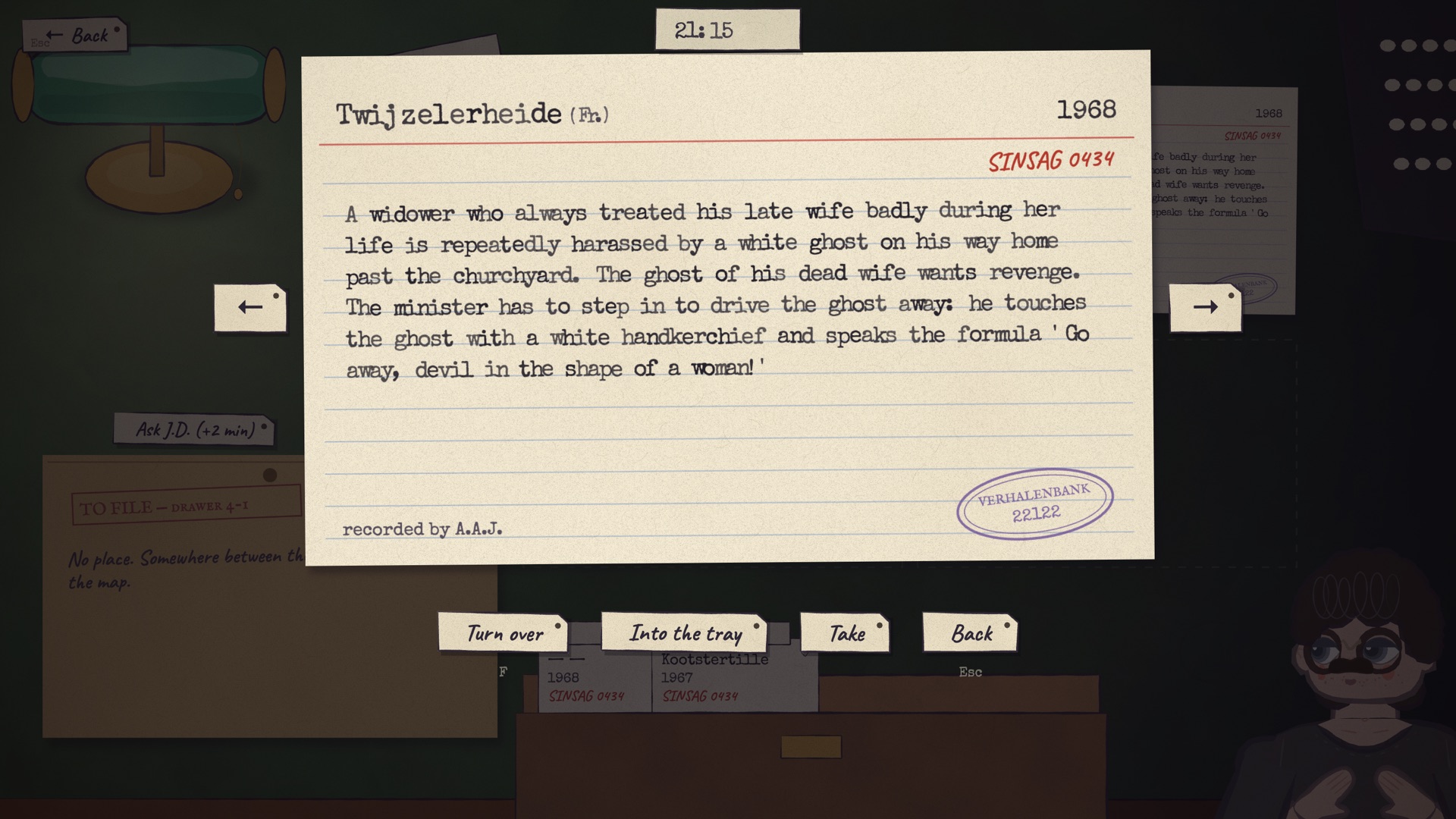
Nachtdienst: reading a card.
Games as a way of telling what we know
A few years ago I could not have dreamed of making games like these. My work (hopefuly!) reaches readers as an article, a figure, or at best an interactive visualisation, but a game of this level would have needed a team and a budget. These two were made in October 2026, each in a few days of (OK, quite intense) back and forth with Claude (Opus 5.5). I strongly believe that the quality of the data is the most important ingredient here. Claude wrote the code, but what it could not supply was the immense archive of tens of thousands of carefully catalogued legends, the work of decades of collectors and archivists, and some knowledge of how those legends were collected. Most of my effort went into deciding how tales should travel, how a tellers and collectors behave, and how the puzzles should work. What astonishes me is that what came out is not a demo but a game that people can actually play. A game that gets something across about the historical practice of collecting and keeping stories: that a collector chooses whom to visit, that a teller decides what to say, that an assistant decides where a card goes.
It’s an exciting way to communicate scientific ideas, and while not something new, it is novel to me. A game is an argument you can walk around in. I think, Sagenland’s end screen makes the point about sampling bias better than any paragraph I have written about it, because you have just made those choices yourself. Nachtdienst makes the catalogue feel like work done by people, because for one night it is your work. Also, the research doesn’t disappear into the game. It is in the design: which stories can travel, which variants a tale can turn into, which puzzle is fair. The game is only as good as what you know about the material. Sagenland is the more ambitious of the two, I think als also a better attempt at turning research into play.
There is a bonus I didn’t expect. The games are another way into the Verhalenbank. A database shows you a list of results, and most of the thousands of stories in it are ones nobody will ever open. In these games you have to read them. You have to in order to to know which half finishes a torn card, which card is misfiled, what to ask a shy teller next. Every card links back to its record, so the game is also a way of browsing the archive. I actually read a lot of legends while making these games, and I learned more about the material from them than in years of working with it. This is not to say that we don’t need the website of the Verhalenbank anymore. On the contrary! But it suggests an archive can have more than one front door.
Play Sagenland at www.karsdorp.io/sagenland, in winter when the nights are long, or around Halloween, when the dead are about. Play Nachtdienst at www.karsdorp.io/nachtdienst-2d, at night, with headphones.